
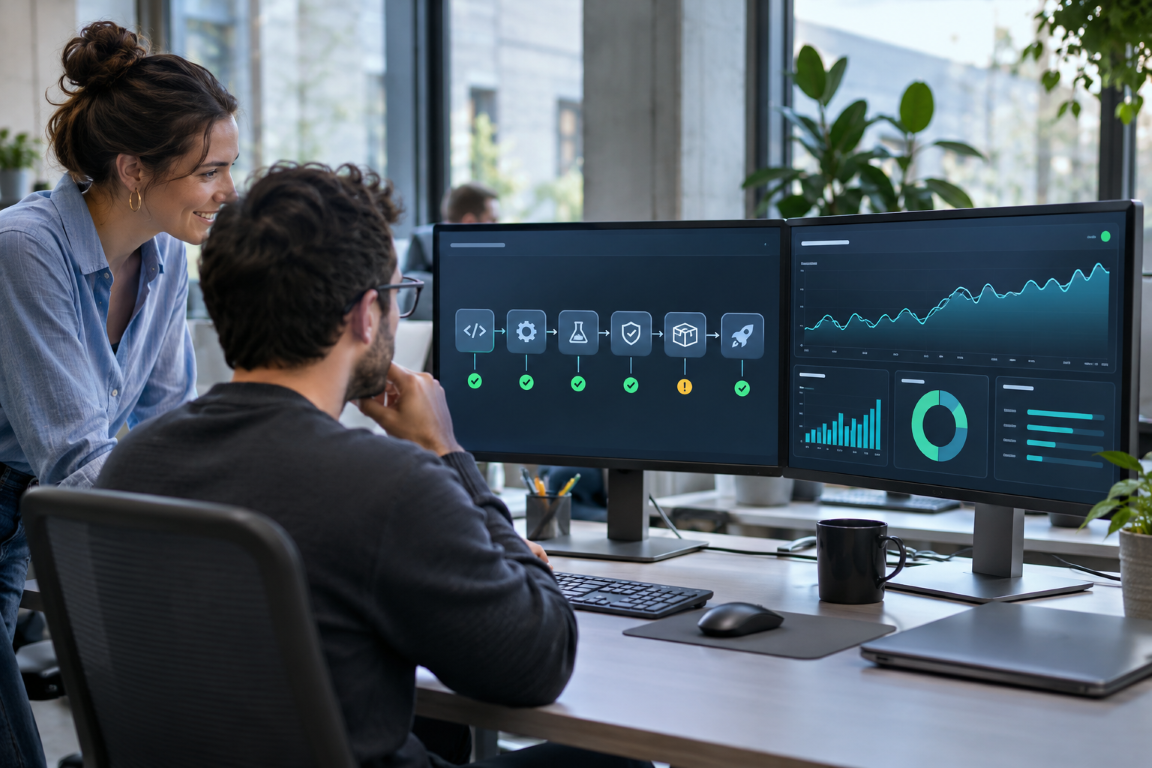
Quality in software often stays invisible until something breaks. A release slips, a defect reaches customers, or a weekend turns into recovery work. Leaders then ask for answers that should have been visible all along. Software engineering fundamentals — product-centric teams, automated quality gates, fast code review, shift-left testing and shift-right observability — make quality something executives can see, measure and improve before the next incident forces the conversation.
Why Fundamentals Belong on the Leadership Agenda
Delivery speed matters, but it is only half the story. Without clear engineering fundamentals, faster coding simply moves problems downstream. Quality then appears late: in production incidents, customer complaints or emergency patches that steal capacity from the roadmap.
Industry guidance is converging on the same point. TechTarget's Damon Garn argues that modern software quality is a board-level concern tied to revenue, brand trust and resilience, and that organizations need to blend shift-left testing with shift-right observability rather than treat quality as a final QA phase. Gartner's 2026 Planning Guide for Software Engineering likewise urges technical professionals to strengthen software engineering basics — especially product-centric delivery — so AI tools actually deliver value.
For executives, the question is whether quality is visible early enough to manage, with shared definitions, automated evidence and outcome metrics.
Product-Centric vs. Project-Centric Engineering
Gartner's planning guide draws a useful distinction. A product-centric operating model focuses teams on delivering and maintaining applications over their entire lifetime. A project-centric model treats teams as responsible for a specific release, after which the work often enters a vague "maintenance" mode.
Product-centric teams keep an ongoing understanding of customers. Software evolves with regular feedback, and the same people who ship a change stay accountable for how it behaves and what customers experience after release. Project-centric habits — temporary teams, handoffs to support, success defined as "we shipped on the date" — make quality harder to see because ownership dissolves after go-live. Leaders who want durable quality should push staffing and incentives toward long-lived product teams whenever the software matters for years, not weeks.
Core Fundamentals That Make Quality Visible
The practices below reinforce one another. Few organizations adopt all of them at once. What matters is that each one produces evidence leaders can review without waiting for a crisis.
A clear definition of done and automated quality gates
Quality becomes visible when "done" means more than code merged. A practical definition of done includes automated checks that must pass before work advances: unit and integration tests, security scans and basic nonfunctional checks where they apply. Harness's State of Software Engineering Excellence 2025, based on responses from more than 650 engineering leaders, reported that 55 percent of build pipelines lack proper quality gates. Without those gates, quality remains a conversation instead of a control.
Fast code review on small changes
Code review still fails when changes are too large and reviews take too long. The same Harness research found that 61 percent of engineering leaders say code reviews take over a day in their organization. Small changes reviewed within hours keep defects cheap to fix. Leaders should watch review turnaround as a trend, not as a scoreboard for individuals.
Automated tests with quick feedback
DORA's test automation guidance is direct: developers should get feedback from automated tests in less than ten minutes on local workstations and in continuous integration. Teams should run automated and manual exploratory testing throughout delivery, not after a "dev complete" phase. When feedback is slow, developers learn less and quality becomes someone else's problem.
Architecture kept visible
Late structural surprises — a module nobody can change safely, coupling that forces multi-team releases, a dependency that cannot be upgraded — are quality problems discovered too late. Lightweight decision records and regular discussions of change risk help leaders see where the next quality tax will appear.
Observability after release (shift-right)
Shift-left testing reduces what reaches production. Shift-right observability validates quality under real conditions through logs, metrics, traces and user behavior. Garn's TechTarget guidance treats the two as a closed loop: production insights feed future tests and design standards.
Vanity Metrics vs. Quality-Visible Metrics
Gartner warns teams against chasing vanity metrics — high code coverage numbers, burndown charts or lines of code — that create a false sense of progress. The guide recommends measuring value, team health, flow and quality, and never using metrics to reward, shame or compare individuals. A side-by-side view helps leaders choose signals that support decisions:
Why AI Makes Fundamentals More Important
AI coding assistants are now part of everyday development. Google Cloud's announcement of the 2025 DORA Report, drawing on nearly 5,000 technology professionals, describes AI as an amplifier: it strengthens teams with good practices and intensifies the problems of teams without them. About 90 percent of respondents reported using AI at work. The research also found a positive relationship with delivery throughput alongside a continued negative relationship with delivery stability.
Without strong automated testing and fast feedback loops, more change volume leads to instability. Fundamentals — quality gates, reviewable change sizes, reliable tests and observability — are how leaders turn AI-assisted speed into trustworthy outcomes. Delivery practices and quality fundamentals reinforce each other; neither replaces the other.
What Leaders Can Measure
Gartner's quality metrics guidance highlights defect escape rate, mean time to recover and accessibility. Pair those with a few engineering trends:
- Defect escape rate: how often defects reach production or a later stage that should have caught them earlier.
- Time to restore service: how quickly the team recovers when something goes wrong.
- Code review turnaround: how long changes wait for a meaningful review, watched as a trend.
- Test feedback time: whether automated suites return results fast enough to guide daily work — DORA's under-ten-minutes target is a useful benchmark.
- Pipeline gate health: whether quality thresholds actually block unsafe changes, or whether teams routinely bypass them.
These measures work best as trends for a product or system over time. They should inform coaching and investment, not public ranking of teams.
Where to Start
Changing fundamentals across an entire organization at once rarely works. A steadier approach:
- Pick one product where quality surprises are costly and the business cares about trust.
- Define quality thresholds in the pipeline so "done" includes automated evidence, not only a status update.
- Make one dashboard leaders actually read, translating gates, defects, recovery and review trends into business language.
- Shorten review cycles by keeping changes small and treating review latency as a shared bottleneck.
- Invest in skills, not only tools: automation, telemetry analysis and cross-functional ownership of quality.
An Example from Industry Practice
Consider a common situation for a mid-sized company with a customer portal. Releases still go out, but quality is mostly discussed after incidents. Test feedback takes hours. Code reviews often wait more than a day. Monitoring answers "is it up?" but not "is the customer experience degrading?" Leadership hears volume metrics and still feels blindsided when something breaks.
A typical improvement path starts with one product team. The team agrees on a definition of done that includes automated gates, trims the test suite until it is fast and trustworthy, and expects small changes to be reviewed the same day. A simple quality dashboard shows gate pass rates, escaped defects, recovery time and review turnaround for that product only. Over time, conversations move from "Why did this break?" to "Which quality trend needs investment this quarter?"
How TISA Software Can Help
TISA Software is an AI-first software engineering company with offices in Houston, Texas and Buenos Aires, Argentina, and an ISO 9001:2015-certified quality management system. We help organizations make engineering quality visible and durable:
- Software Factory teams that embed automated quality gates, review hygiene and observable delivery into how products are built.
- Staff augmentation to add experienced engineers who strengthen fundamentals inside an existing team.
- Legacy modernization experience for systems where hidden architecture and weak testability make quality hard to see until late.
- AI-assisted engineering practices with review and automated testing built in, so faster development stays trustworthy.
If quality in your organization is still invisible until something breaks, we'd be glad to help you find a practical place to start. Contact us to start the conversation.


